Source: Bureau of Meteorology
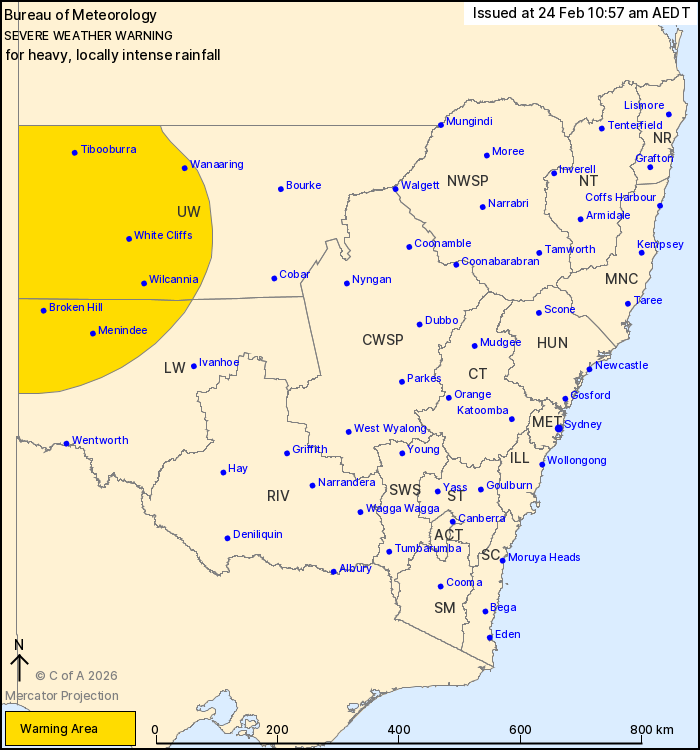
For people in parts of Lower Western and Upper Western Forecast
Districts.
Issued at 10:57 am Tuesday, 24 February 2026.
HEAVY TO LOCALLY INTENSE RAINFALL IN THE NORTHWEST.
Weather Situation: An extremely humid airmass lies over central
Australia, focused around a slow-moving tropical low over the
southern Northern Territory. A trough extending south of the low is
forecast to deepen today, increasing the risk of heavy falls.
HEAVY RAINFALL which may lead to FLASH FLOODING is forecast about
parts of the Upper Western and Lower Western districts today and
into Wednesday. Six hour rainfall totals between 30 and 60 mm are
likely. 24 hour rainfall totals between 50 and 90 mm are likely,
with isolated totals to 130 mm possible.
Locally INTENSE RAINFALL which may lead to DANGEROUS AND
LIFE-THREATENING FLASH FLOODING is also possible with isolated
thunderstorms today, becoming less likely by Wednesday afternoon.
Isolated six hour rainfall totals of around 100 mm are
possible.
There remains uncertainty around the location of the heaviest
falls, as well as the future movement and strength of the low
pressure system that is driving this weather. Periods of heavy
rainfall may affect parts of western New South Wales into
Thursday.
Flood Watches and Warnings are current for the area. Please refer
to https://www.bom.gov.au/weather-and-climate/warnings-and-alerts/
for more information.
Locations which may be affected include Tibooburra, Broken Hill,
Wilcannia, White Cliffs, Wanaaring and Menindee.
121mm was recorded at Winnathee (near the SA border) in the 24
hours to 9am this morning, mostly falling in 6 hours during
Monday.
The State Emergency Service advises that people should:
* Don't drive, ride or walk through flood water.
* Keep clear of creeks and storm drains.
* If you are trapped by flash flooding, seek refuge in the highest
available place and ring 000 if you need rescue.
For emergency help in flood and storms, ring the SES on 132
500.
Stay updated on the Hazards Near Me NSW app or the ACT ESA website
(https://esa.act.gov.au).
24/Feb/2026 12:02 AM